Related Posts with Thumbnails

Shooting cascades in Papa-a

As soon as I saw small cascades running down the stream, I immediately thought it would be good to do long exposures. It was just disappointing that I did not bring my tripod [again!]. But then I felt I had to shoot.

Awesome sunset in Butuan City

It is not very often you get to witness a stunning sunset that gives you goosebumps. For a photography junkie like me, you should never, never, never let it pass just like that.

Winning a photo contest

Winning a photo contest for the first time (well, officially and with a prize for that matter) gives a different high!

Missing Cordi

From afar, I could already see the clouds rolling over the mountaintops. It was a sight to behold. So I asked the driver of our vehicle going to Buguias, Benguet to stop so I can capture this once-in-lifetime scene.

Cory Aquino: An inexhaustible gift to democracy

She further stressed the belief that the Filipino people, as a nation, can be great again. During her last State of the Nation Address (SONA), she said: I believe in the inexhaustible giftedness of the Filipino people.

Conversation with a cab driver on climate change

Ironically, this cab driver who would like to contribute something help curb climate change and global warming, by planting his narra tree becomes discouraged and disappointed...

At home [and at peace] with HDR Photography

HDR is not bad per se. HDR is nice to learn. In fact it is a must for non-pro like me to learn HDR to learn more about shadow and light and exposure, which is the crux of photography.

Showing posts with label WOW Pilipinas. Show all posts

Friday, July 29, 2011

Explored!: Reloaded

Explorednew

Maintaining several blogs can be quite laborious, especially if you begin to suddenly face a writer's block--or worse, you have nothing to write about [because you feel that everyone is writing about it anyway] or simply you are dead beat or simply does not have anything to write at all.

I have wanting to blog every so often, but I was up for something that I have protracted for so long.  It is my travel blog called "Explored!"  This has been shelved for more than a year and it is only now that it is beginning to take its own pace and have its own following.  Unlike my Mono-logues blog, which has gained a relatively strong following, Explored! needed more push, which in the end, made this blog suffer.

Anyway, enough of ranting and justifying. I would just like to invite the readers of this blog to cross over Explored! for some stories about my travels. See you there!

Wednesday, July 13, 2011

Win a free trip to Boracay


Hmmmm...I might as well join this contest.  Nothing to lose!  And why not? If i'd be lucky enough, I would spend my birthday in Boracay, which I would definitely blog about HERE!

Here are the details:

WOW Philippines Travel Agency, Inc. since 2005 has been one of the most respected and trusted names for travel and tour packages. We are the No. #1 travel agency in the Philippines specializing in vacation packages for Boracay Philippines.

Win A Free Philippines Package - Enter Contest Here! Sign Up Here to Win a Free Philippines Package

Free Boracay Package Inclusions:
1. 3 Days & 2 Nights Hotel Accommodations at Punta Rosa Boracay Beach Resort
2. Free Roundtrip Airfare
3. Free Roundtrip Land & Sea Transfers
4. Free Welcome Drinks
5. Free Daily Continental Breakfast
6. Free Use of Sun Deck & Beach Beds

Enter Our Free Boracay Tour Package Giveaway - Boracay Packages

For more details of this contest, visit: 
WOW Philippines Travel Club

Saturday, September 18, 2010

Video | Manila : Queen of the Pacific


My late father always talked about his Escolta walks.  As a kid who grew in the province, I never had an inkling of how Manila looked like.  I only knew about it from my father's pictures, and later on when I had the chance to tag along with my parents.  He endlessly talked about how beautiful Escolta and Avenida Rizal was.

We know that Escolta was the center of business and trade, much like Ayala Avenue and the Entire Ayala Center, then we had Cubao, Greenhills, and now, we have Libis, Rockwell, and the latest to grow are Fort Bonifacio and Madrigal Business Center in Alabang.  Avenida Rizal, then, was the center for the culture and the arts, where movies were shown and stage plays were held--like London's West End or New York's Broadway.

Having the chance to work in Intramuros in the early 90s made me appreciate the ruins and architecture of Old Manila, and of course, Escolta and Avenida Rizal.  Intramuros, for its being a tourism destination is being preserved and reconstructed to its old glory. Escolta, since early 90s has not changed much.  Perhaps, there are only more traffic and people now.  Needless to say, Avenida Rizal is in shambles. This dingy and grimy place is now home to rotting buildings, peddlers, crooks, street people, and heavy traffic. It is ironic that this strip where Manila culturati has taken its roots, has become a place for lewd movies and sexy stage performances, and worst, a place for prostitution.
Under Mayor Lito Atienza, Avenida Rizal, which was even named after the country's national hero, was given a much-needed facelift.  It was cleared from traffic and was converted into a street mall.  Now, under the leadership of Mayor Lim, the place has gone back to its sham image.

In my photowalks to these places, it is just sad to witness Filipinos' lack of appreciation for history, culture and tradition--which must translate into preservation or restoration of historical places and architecture.  I could only marvel at the thought that Manila was once a pride in Southeast Asia or even the Pacific.

Well, it is not too late to bring back the lost glory of Manila. There are still buildings that can be salvaged from rotting and total destruction.  We only need to clean up these places and at least repaint their facades, and once and for all, get rid of those hanging cables and wires!  Bury them under!   In fact the El Hogar building in Binondo area is now undergoing a major renovation and restoration to be a future site for business and trade. I just hope the National Historical Institute and Manila's planner's would be more gungho about this. 


Do you want to subscribe to this blog?


Friday, May 1, 2009

Lang-ay Festival 2009


5-1-2009
I took another marathon trip last April 6 and 7 to be just in time for Mountain Province's Annual Lang-ay Festival.

Witnessing and covering the event was exhausting, but it thrilled me just the same because I got the chance to mingle with the different tribes of the Cordillera people. Watching the SLU Dance Troupe perform was likewise a source of pride for my alma mater. The street dancing was superb as the participants gave their best to entertain the locals and tourists. And communing with them along the historic Chico river where the governor treated all participants for lunch was a humbling experience--where all people become co-equals.

This years' theme was "Nurturing History and Culture".

It was an honor to be part of this. If my schedule permits, I will definitely go back next year.


You can read the full story at: Lang-ay Festival of Mt. Province
...

Sunday, February 22, 2009

Experiencing Hot Air Balloon Fiesta


Preparing for the flight

Seeing them on TV, especially in features in National Geographic (not exactly sure about it) and Discovery Channel makes me feel so young at heart! I know that they are huge and they run on winds and hydrogen, but seeing them right before my eyes is definitely an altogether different experience.

Together with my Flickr friends, we started our travel from Quezon Avenue to Clark at 4:00 Am and arrived before 6 AM. It was my first time to attend the Hot Air Balloon Fiesta last February 15, and was just surprised to so many cars and people lining up!

But we were lucky to have a friend's friend to buy tickets for us so the queuing up was a little shorter. Thank God! or else we would not see the preparation and the start. It was worth the heat, the confusion, and physical fatigue....it was indeed an awesome experience! I might go there again next year and bring my sons with me!

You can see my 2009 Hot Air Balloon Fiesta HERE.


....
Back to TOP

Friday, May 30, 2008

My updated Lakbayan Rating

I has been 11 months after I got my Lakbayan rating. So I am now updating my Lakbayan Grade. Nothing much has changed ex except I think that I have been more often in Cagayan de Oro, been to Batanes, and Romblon in the past months.


My Lakbayan grade is B+!

How much of the Philippines have you visited? Find out at Lakbayan!

Created by Eugene Villar.


So get your grade now....I am now a "B+" from a "B" Traveler in the Philippines. I wish that I could be A- at least.

Sunday, October 21, 2007

Romblon Chronicles Part 2: Facing fear

IT TOOK ME ONE HOUR to reach the town of Calatrava via a big version of jeepney. The road was in good condition except for some unpaved parts. It was fortunate that the rain the previous night spared me from heat and dust. Actually, it was a fine day, when you could smell the sweet morning breeze, the scent of freshly mowed grass, appreciate the newly plowed rice fields waiting for new seeds to be planted, the people were nice, and most of all, seeing the sun rays peeking through the mountains and trees along the road.

Continue reading

Monday, September 24, 2007

Basic courtesy guides for an “Ipula”

“Ipula” is a term used by Ivatans for someone who is not a native of Batanes. They would know if you are an Ipula or not, simply because you are a new face, and you do not speak their dialect.

Ivatans are naturally courteous people. It is very heartwarming to know that the basic virtues taught by our grandparents and our parents still thrive in Batanes. Why not? Perhaps we can attribute it to the fact that they are an island and rarely do we, Ipulas, have the chance to intrude in their culture and tradition. It is because we feared Batanes because of its strong typhoons. Add to it the fact that transportation then was not that reliable.

Because of the extreme weather that Batanes is known for, it is only in the past two decades that Batanes has been fully explored as an alternative tourist destination. For those who fear Batanes’ extreme weather, it is good to note that you no longer have to fear being stranded—at least for now, because the strong typhoons has not passed through Batanes for the past 20 years. If you want to have an idea what a strong typhoon in Batanes is, it is very much much like typhoon Milenyo in 2006—only a little stronger, according to Mang Nards who drove us around.

So here are some reminders for Batanes wannabe explorers:

  1. Everyone calls the elders “uncle” or “auntie” which is a form of endearment and a sign of respect—very much like “tito” and “tita”.
  2. When you are invited into a household, or introduced to an elderly, do not forget to “kiss the hands” of he elders, by doing the traditional “Mano po”
  3. Whenever you meet someone along the street, make sure you have that ready smile and say “Magandang umaga/ hapon po!” (Good morning/ afternoon!), or just simply say “Hello!” (and do not misinterpret it that the stranger who said "hi" or "hello" has the hots for you!)
  4. When taking photos of people, just ask for their permission, and they will oblige. Thank them afterwards.
Let us help them preserve their culture. It does not hurt much if we say a simple “Hello!” One thing that makes me feel good is their courtesy.

I can never forget that.

Friday, September 21, 2007

Sweet honesty

Written on a small white board, the house rules say:


  1. Self-service po lamang. (Self-service only.)
  2. Get what you need.
  3. Please pay [for] whatever you get.
  4. If you have no change, please knock at the next door. If no one answers, sorry. So you give more than the price. Salamat po (Thank you) and may your tribe increase.
  5. Remember, honesty is the best policy.
  6. Thank you and have a happy day!

Honesty Coffee Shop is located in Ivana, the third town from Basco, Batanes. It does not have a store clerk to attend to your needs. It does not have a spy camera or a CCTV to watch you cheat. But all in the name of honesty, which is home-grown in Batanes, you can buy candies, biscuits or drink coffee.

Looks cool! Right? What if this coffee shop is located in the metropolis? Would you think it will survive from the hands of crooks? I do not think so.

Dictionary.com defines honesty as:

  1. the quality or fact of being honest; uprightness and fairness.
  2. truthfulness, sincerity, or frankness.
  3. freedom from deceit or fraud.

I am not a 100% honest person, but I know if an act or thought is WRONG and I am sure, I am on the right track not to be entangled in a situation like THIS and THIS.

As Thomas Carlyle puts it:

Make yourself an honest man, and then you may be sure there is one less
rascal in the world.

Here are more quotes and resources on HONESTY:

Henry Louis Mencken, A Little Book in C Major, 1916

It is hard to believe that a man is telling the truth when you know that you
would lie if you were in his place.

Ambrose Bierce

The hardest tumble a man can make is to fall over his own bluff.

Mark Twain

One of the most striking differences between a cat and a lie is that a cat has
only nine lives.


MORE ON HONESTY


Note: Quotes were lifted from: Quote Garden


Wednesday, September 19, 2007

Basco's Casa Napoli

Anybody who is new to Batanes, a pizzeria is a rare find. One would not expect a fine pizza parlor that serves pizza (of course) with real mozzarella cheese. We are just lucky to know locals who are familiar and frequent Casa Napoli.

Casa Napoli is located along Abad Street in Basco and is actually a residence converted into a pizzeria by its owner and chef Javier, who used to work in a ship. The place literally offers a colorful ambience that will enliven your damp spirit and rejuvenates your tired body after a day’s work or a trip to Batanes’ scenic spots becuase of its colorful interiors—not to mention, of course, the sumptuous and mouth watering pizza they offer at a very reasonable prize--and one that is comparable to some popular pizza in Manila.


We were five and we ordered two, and here is the proof that we simply loved the taste!


Javier gamely posed for me when I told him I am going to blog about Casa Napoli.
There is no X-deal. I just wanted to promote something that is good and worth-mentioning.

If you happen to plan to go to Batanes. Do not miss this pizzeria. Do not worry about being lost. Just ask around. In Basco, Batanes, everyone knows everybody. And here is the best thing about roaming around in Basco, Batanes—everything is in walking distance. No kid!

Sunday, September 16, 2007

Windows of Batanes

I am back from a week of hibernation and I am coming back with some great photos to share!
Read on....


I was fascinated at how this PC computer perched on the table with the window as its backdrop.

Instantly, I got an idea for my blog, and windows became my fetish during my short Batanes sojourn, so the title:
Windows of Batanes.

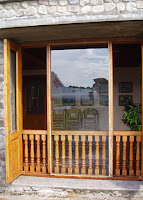
Aside from the colorful, but otherwise monotonous blue paint of windows in almost every house, I find the windows of Batanes houses brimming with character. The reason for blue colored windows (they have a penchant for blue color) is the color being attributed to the color of the sea. True enough, Ivatans have a daily commune with the sea, not mentioning its mountains and rolling hills of greenery. The way the windows were built also serves a very practical reason. They are built receding a few inches from the outer wall (like an awning) which would prevent strong winds during typhoon to ram through the windows.

Take a quick look through these windows, and get the feel of actually peeking through them:


The windows of Batanes houses speak about one’s socio-economic status.
There are windows that have gone through tough and rough times


and everything that one person can see from within or from outside only resides in the deep recesses of memories, if there is one at all.

There are some that looks drab.

But the one can never be bereft of something that mesmerizes the tired senses.
Others are simply beautiful in their own way,

And some continue to exude beauty and unfazed by life’s difficulties.

It always pays when you see from within, and discover the beauty beyond.


Some become a reflecting mirror (literally and figuratively)

And of course, a very common practical use—windows are used for communicating with your neighbors or visitors.

This one serves for the dweller to see more of the outside world.

Which window are you?

See more of my photos at : http://www.flickr.com/photos/ding-inkblots/

Tuesday, August 28, 2007

Sunset in Digos

Taken in one of my trips to Davao del Sur more than two years ago. We just attended one of the meetings of the cooperatives in Digos and going back to Davao City, we saw this God’s beautiful masterpiece. It was a tiring day and that meeting was the last leg during my trip.

Certainly, scenes like this are always a sight to behold–one that makes you leave your pains and worries behind.

As Amy Lowell aptly puts it in her poem:
The Poet

What instinct forces man to journey on,
Urged by a longing blind but dominant!
Nothing he sees can hold him, nothing daunt
His never failing eagerness. The sun
Setting in splendour every night has won
His vassalage; those towers flamboyant
Of airy cloudland palaces now haunt
His daylight wanderings. Forever done
With simple joys and quiet happiness
He guards the vision of the sunset sky;
Though faint with weariness he must possess
Some fragment of the sunset's majesty;
He spurns life's human friendships to profess
Life's loneliness of dreaming ecstasy.

Friday, August 24, 2007

When South meets North

The ladies in the photo are not Igorots. They are young Muslim (Moro) professionals who belong to the 5th cohort of Congressional Internship Program for Young Muslim Leaders (CIPYML), which is a program I used to handle. One of their internship activities is to visit local government units where they can learn the interface of legislative and executive functions and how these are supposedly translated into programs and services.


In June last year, I brought them to Baguio not only for some R&R but to learn more about the culture of Igorots, and more importantly about the Cordillera Administrative Region (CAR).

The Igorots and Moros share a yearning for self-determination. It would be recalled that the Igorots pushed for the creation of the Cordillera Autonomous Region during the Aquino Administration, but they failed to deliver the votes--thus the creation of the Cordillera Administrative Region, instead.

Much has been said about the Moros in their quest for self-determination (Unless you want me to discuss and you have the patience to read centuries of historical accounts). But my dissertation is rather simple. Like many Filipinos, it is my fervent prayer for this issue to finally come to a resolution so that peace and development would finally thrive in Mindanao, particularly in the ARMM and other conflict-affected areas in Mindanao. It is easier said than done, but Insha'Allah! (God willing!), we would also find a way to resolve this issue.

Much has been said against the Moros. I cringe at the thought that they are badly stereotyped. Having the chance to relate with them, getting to know what they think and aspire for, and going through what they feel, I had a better understanding of what they are, of their cultural pride and religious beliefs, as well as what they are fighting for.

As they took fancy of the Igorot costumes in Mines View Park, it was, for me, a meaningful learning experience. While I took this photo because they keep on saying they look beautiful in Igorot costume [so I should take their photo, sige na nga!], some more important thoughts were rambling in my mind. Their visit to Baguio and Benguet has further made them stand proud to belong to an indigenous people--and this became a special occasion to cherish the meeting of two great cultures of the South and the North.

Finally, if we only give ourselves a chance to don and get the feel to be in someone else's clothes (or walk in someone else's moccasins), it becomes a starting point for us to fully understand each other--we would be ready to break stereoptypes and other barriers to walk the path and lay down the foundation towards a lasting peace and development in Mindanao.

Salaam! (Peace!)

Wednesday, July 25, 2007

Would you like to be exiled to Dapitan?


Figure it out: What was it like to be deported and exiled 115 years ago, when there were no telephone, malls, family, friends and just going there would take you days? And your only link to the world was through a snail mail, which perhaps you could not even depend upon because you fear that, perhaps, the Spaniards were prying into your letters to Josephine Bracken or Ferdinand Blumentritt.

Being deported and exiled to Dapitan (which is even within the Philippines) at that time was, perhaps, an already mind-boggling experience. I would also surmise that it was already a brutal and severe punishment to anybody who would be filibustering against Spain. More than a punishment, the Spanish friars isolated Rizal in that remote town in Mindanao and tried to nip the bud, thinking that he would keep his mum and not be able to lift a finger on the burgeoning rebellion of Filipinos against Spain.

But Rizal must have been laughing at the Spanish friars then. I myself would do the same. The people are nice. The place is clean. The environment is just loveable--even up to this day, 115 years after. Rizal was just so clever that instead of sulking in his nipa hut and wallow in misery for his deportation, he kept himself occupied with so many things to use up his supposedly idle time.

For an urbanized person like him, he would surely find himself having a difficulty adjusting. But reading historical notes about his exile, and having experienced Dapitan myself for a number of times, Rizal never had a hard time communing with the Dapitanons.

Perhaps, one of the reasons why Rizal [supposedly] enjoyed his exile in Dapitan, (aside from the fact that he busied himself in community development--was he also a development worker like me?), is the fact that Dapitan is a beautiful place. Aside from the beautiful landscape, lush vegetation, fresh and mouth-watering seafoods, and warm and amiable people, one of the best things about Dapitan is its sunset.

In one of my trips to Dapitan, and after enduring an equally delightful boat ride to and from Selinog Island (or Dapitanons say Sulinog) we took some refreshment in one of the restaurants along the beach where we also held a short meeting about our recent trip on how we could further develop the community in the island. In the middle of the meeting, I was in awe with what I saw—the sunset was so colorful and beautiful that I ended up calling for a break just to record the scenery in my camera.

Rizal’s favorite spot in Dapitan was the Mi Retiro rock. And just like Rizal, I could imagine myself every afternoon, sitting on the Retiro Rock and waiting for the sunset.

I consider Dapitan to be one of the most livable cities in the country and if I have my way, I would definitely live there longer than Rizal did for four years.


Photo I took in the middle of a meeting at a seaside resto in Dapitan

Playing dogs at dusk

Rizal's House in Dapitan


Backtrack: In July 1892, Rizal was deported to Dapitan due to his implication in the nascent rebellion againt Mother Spain. His exile, however, was not put to naught by keeping himself busy building a school, a hospital, water supply system, engaged in farming and horticulture. He also taught science to his pupils.

On July 31, 1896, Rizal left Dapitan with a heavy heart. As Dapitan.com aptly puts it:

As the steamer pushed out into the sea, Rizal gazed for the last time on Dapitan waving in farewell salute to its kind and hospitable folks and with a crying heart filled with tears of nostalgic memories. When he could no longer see the dim shoreline, he sadly went to his cabin and wrote in his diary: "I have been in that district four years, thirteen days, and a few hours".

This month of July marks the 115th anniversary of Rizal's exile in Dapitan.

This blog entry is also posted at: PinoyBlogoSphere and Mindanao Bloggers

Friday, July 20, 2007

Pristine Selinog Island

Pristine Selinog Island
My friends who saw this photo were always asking me where on earth is this beach.

I would say that this is the best beach I have seen so far. Even the famous Boracay Island could not compare to its pristine and crystal-clear water. The downside, however, is that the island does not have fresh water and the community thrives on rainwater. During the summer months, they have to fetch water either from Dapitan City or the nearby Apo Island in Negros Oriental.
The small community lives on fishing, some crops, sari-sari store, and salt-making, which happens to be one of the alternative livelihood projects under the "Zamboanga Peninsula Upland, Lowland and Coastal Resources Management Program" that I handled a few years back through the Philippines-Canada Development Fund. The salt-making projects was managed by a local fisherfolk association and supervised by the City Agriculture Office of Dapitan City.

This is Selinog Island Beach--2 hours by boat off the coast of Dapitan City.

Selinog Island, view from the plane. I took this after we took off from Dipolog City.
The island from afar. Are we there yet?


Almost there!
 
Off the boat, at last!

The lighthouse at the other side of the island facing equally captivating Apo Island in Megros Oriental


This blog entry is also posted at PinoyBlogoSphere and Mindanao Bloggers

Enhanced by Zemanta

At 7400 feet


At 7400 feet
Originally uploaded by Ding's Inkblots
It was my second time to pass through the Halsema Highway in Benguet where we can find the highest point of the Philippine Highway System.

The first one was 16 years ago, when Halsema Highway was still a dirt and rocky road and only the marker and cogon grass were visible in the area. I had no camera with me then that is why I promised myself that I should have a picture when I have the chance to travel through Halsema Highway again.

Now, there is a view deck, which is at the left of the photo, and a few stores left and right.

Sad to say, I liked it better then when the place was more rustic and reaching the point would seem a conquest for every Fillipino traveller. The road then was really bad. Nonethless, progress has taken its steps in this part of the Philippines and is a breeze passing through it. Although development has a drawback. See what have they done to the great view with the sari-sari stores and souvenir shops along the road.

With me were Joyce and Sharon from the Peace and Equity Foundation (Joyce and Sharon) and Vince from the Advocates for Philippine Fair Trade, Inc.

After two hours we were in Mt. Data to attend the launch of the First National Weaving Congress.

(Photo courtesy of Vince's camera because I was running out of batteries then.)

Wednesday, June 27, 2007

I am a "B" Traveler!

I found this really cool site which was part of an email to me by a friend. You can rate yourself bly clicking teh areas where you have visited. And I found out that I have a "B" rating. Not bad!


And this is the map that shows my travels around the Philippines:


You can access this at http://forge.codedgraphic.com/lakbayan/ or at the main website of Joji Alcantara at http://www.witerary.com/

Monday, May 7, 2007

Igorot Foot Massage


LAST APRIL 23, I attended the Launch of the First National Weaving Congress in Mt. Data Hotel, Bauko, Mountain Province. We were treated to a cultural presentation. One of the highlights of the presentation is the Igorot foot spa, where some participants obliged.

The foot massage, according to Manong who gave me one after the conference, is a pasttime of elderly men. After a hard day’s work, their sons give them the footspa in their “dap-ay” (huts). The “technology” uses coconut oil and two sticks of bamboo which are rubbed alternately on their soles, until they doze off.

When I had mine in my room, it gave me that tingling feeling, which really sooths you with the “kiliti” , until it become more at ease with the rubbing of sticks. I think the secret there is the “kiliti” factor which runs up to your spine and head until you get goose bumps (got the idea?). It is synonymous to laughing, which makes you secrete some hormones that will calm you down after.

While we hanker for other Asian-type massage (e.g. Thai, Chinese reflexology), it was a suprise even among the other Cordillera participants that we have this indigenous way of relaxation.


Also mentioned at: Pinoy Centric


Wednesday, May 2, 2007

Weaving the tapestry for saving the Cordillera weaving industry

I had a chance to work again with the Cordillerans, specifically with the weaving industry. The following is an excerpt of the summary of the study I did for the Peace and Equity Foundation, CORDNET, and DTI-CAR.

FOR CENTURIES, the tribal people of the Cordillera in Northern Philippines have hand-woven the rich tapestry of their culture and heritage into the tight-weave designs we see today. Each community group has their respective designs, colors, and symbolism. One can easily identify one group from another by the dresses that they wear.[i] Moreover, the blankets and articles of clothing that they produce by means of the backstrap loom not only fulfill a practical function but also play a part in religion and ritual.[ii]

Inasmuch as weaving is an important element and component of the Cordillera culture, it does not only become an alternative source of income. More importantly, it becomes a family activity. Wives, husbands and children have a role to play from, cotton separation, dyeing, drying, spinning and weaving. Back strap looms are handed down either as heirloom or as gifts from the husbands. It is a living tradition. Stores may close down but the tradition lives on.

With strong cultural exchange and influences, introduction of technology, and consumerism, the weaving industry in the cordillera faces a great challenge.

Over the years, the industry has to confront the following concerns/ issues:[iii]

  • Diminishing number of or ageing skilled weavers,
  • Market development –
  • Enterprise management
  • Product development
  • Technology
  • Gender equality issues on multiple role of women
  • Lack of credit for the weaving industry.

Woven materials from the Cordillera have taken many forms, but sometimes, these woven materials no longer impact to buyers as something that is indigenous, and symbolic or have significant cultural meaning – it simply becomes a bag, a table runner, or a tapestry on the wall.

Amidst modernism and utilitarianism, Cordillera woven products must find its niche—one that is cultural, but also functional.

NOTES:
[i] Available at: http://www.slu.edu.ph/offices/arts_music_culture/museum/collections.jsp. Downloaded on April 21, 2007.
[ii] Available at: http://www.filipinoheritage.com/arts/visual-arts/pre-colonial-period.htm. Downloaded on April 21, 2007.
[iii] The need to validate these initial impressions would be very important in the future program assistance for the weaving industry. The separate case studies I have facilitated have validated these issues. The case studies did not intend to make a full-blown study of the entire weaving industry of the Cordillera Administrative Region. It aimed to provide a quick glance of the status of the weaving industry in the selected municipalities and specific weavers associations/ cooperatives. Information on these groups and community-specific conditions and issues would serve as the start-off point for future technical and financial assistance. Nevertheless, the study was also juxtaposed with the bigger scenario or the entire weaving industry to establish the validity of the findings, as well as to properly situate the varying conditions of the industry in each locality.

See related article at: BAGUIO CITY ONLINE, WOW BAGUIO, AND CORDILLERA ONLINE


Tuesday, May 1, 2007

Baguio vignettes


(Note: I wrote this sometime in 2004).


Anything about Baguio is good and beautiful to me.

Why? I grew up there as a person. I studied there for 4 years and worked for another 2 years. Despite some heartaches and difficulties, Baguio has a special place in my heart. I do not know exactly the reason why I would never, ever forget Baguio! That is why it was hard for me to leave Baguio in 1991. Had it not for a career change, I would never leave Baguio. In fact I even had a pajama send-off party with two of my girlfriends (dahil kami na lang ang natitira sa barkada that time), and there I had to let go of my favorite cardigan and my fluffy white mufflers to each of them, and going home at 6 am, practically chilled! Who would not? That was January and the coldest month of the year!. Anyway, we slouched in the attic and ate cookies, baked spaghetti with lotsa mozzarella cheese as toppings, barbecue, and soda courtesy of my girlfriends. We talked till the wee hours in the morning—about our present lives then, our plans in the near future, and what we would become in our respective careers, and many more! This reminds me of the conversations of 3 young professionals inside the bus on my way home. Just like us then, they were 3—one guy and 2 ladies, saying parting words because the 2 ladies are going abroad, and they also wondered if they would still see each other again. Well, that scenario made me smile but at the same time made me sentimental again that drove me this afternoon to email my girlfriends abroad and my buddy here in Manila—telling them I terribly miss them. (And I almost cried while writing that email!).

Looking back in time, and seeing the present is always my favorite pastime, which is a form of therapy to me. Dreaming about the future is something I always look forward to—everyday in my life. And having the chance to dream about my future empowers me to take control of my life.
---------

Twitter Delicious Facebook Digg Stumbleupon Favorites More